
Introduction
Machine learning techniques are transforming how businesses, researchers, and everyday users interact with data. From personalized recommendations to fraud detection, these techniques help systems learn patterns without explicit programming. For beginners and intermediate learners, understanding core methods can open doors to exciting opportunities in data science and technology. This guide explains the fundamentals in a simple, practical way, making it easier to grasp key concepts and apply them in real-world scenarios. Whether you are a student, professional, or enthusiast, mastering these techniques can significantly boost your skills.
What are machine learning techniques?
Machine learning techniques refer to a set of methods and algorithms that allow computers to learn from data and improve performance over time. Instead of being manually programmed for every task, systems use patterns and statistical models to make decisions.
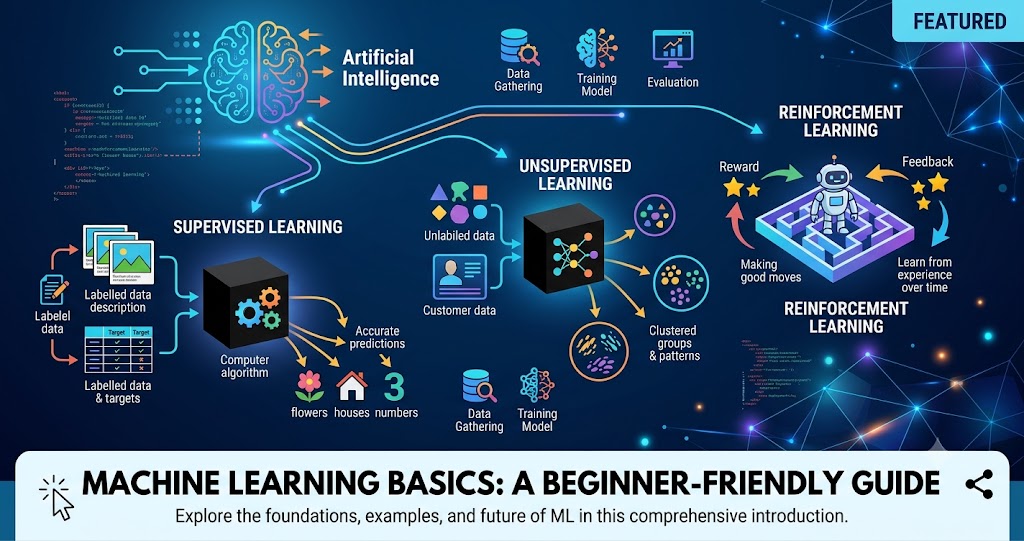
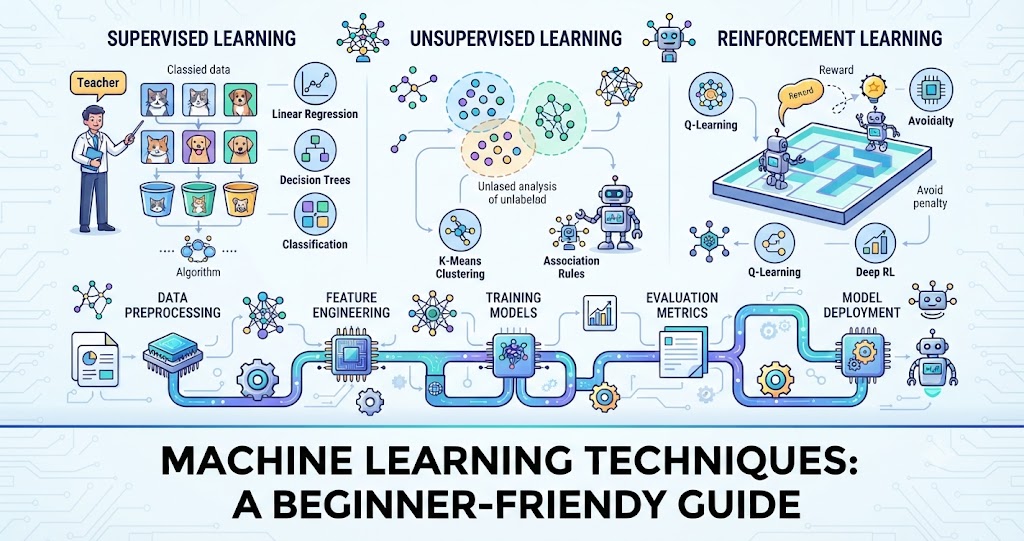
Common types include supervised learning, unsupervised learning, and reinforcement learning. For example, supervised learning uses labeled data to predict outcomes, while unsupervised learning identifies hidden patterns in data without labels. These are widely used in areas like healthcare, finance, and marketing.
Why are machine learning techniques important?

Machine learning techniques are important because they enable smarter decision-making and automation. Businesses rely on them to analyze large datasets quickly and accurately.
They also help improve user experiences, such as recommendation systems on streaming platforms. Additionally, these techniques support innovation in fields like medical diagnosis and autonomous vehicles. As data continues to grow, the importance of these techniques becomes even more significant.
Step-by-Step Guide
1. Understand the Problem
Start by defining what you want to achieve. For example, predicting house prices or classifying emails as spam.
2. Collect and Prepare Data
Gather relevant data and clean it. Remove errors, handle missing values, and format it properly.
3. Choose the Right Algorithm
Select suitable machine learning techniques such as linear regression, decision trees, or clustering based on your problem.
4. Train the Model
Feed data into the algorithm so it can learn patterns. Split data into training and testing sets for better accuracy.
5. Evaluate Performance
Use metrics like accuracy, precision, or recall to measure how well your model performs.
6. Improve and Optimize
Fine-tune parameters and try different models to achieve better results.
Benefits
- Improves decision-making with data-driven insights
- Automates repetitive tasks efficiently
- Enhances customer experience through personalization
- Detects patterns and trends quickly
- Scales easily with large datasets
Risks or Disadvantages
- Requires high-quality data for accurate results
- Can be complex for beginners to understand
- Risk of biased outcomes if data is unbalanced
- High computational costs for large models
- May lack transparency in decision-making
Common Mistakes to Avoid
One common mistake is using poor-quality data, which leads to inaccurate predictions. Always ensure your dataset is clean and relevant.
Another issue is overfitting, where the model performs well on training data but fails on new data. To avoid this, use proper validation techniques.
Beginners often choose complex models without understanding the basics. Start simple and gradually move to advanced machine learning techniques.
Ignoring feature selection is another mistake. Selecting the right variables improves model performance significantly.
FAQs
1. What are the main types of machine learning techniques?
The main types are supervised, unsupervised, and reinforcement learning.
2. Do I need programming skills to learn machine learning techniques?
Basic knowledge of Python or similar languages is helpful but not mandatory at the start.
3. Which industries use machine learning techniques?
Healthcare, finance, retail, and technology industries widely use them.
4. How long does it take to learn machine learning techniques?
It depends on your background, but basic understanding can be achieved in a few months.
5. Are machine learning techniques difficult for beginners?
They can be challenging, but structured learning makes them easier.
Expert Tips
Start with simple algorithms like linear regression before moving to advanced models. This builds a strong foundation.
Practice regularly using real datasets. Platforms with open datasets can help improve your skills quickly.
Focus on understanding concepts rather than memorizing formulas. This makes it easier to apply machine learning techniques in different scenarios.
Stay updated with trends, as the field evolves rapidly. Reading case studies can provide practical insights.
Collaborate with others or join communities to learn faster and solve problems effectively.
Conclusion
Machine learning techniques are powerful tools that are reshaping industries and creating new opportunities. By understanding the basics, choosing the right methods, and practicing consistently, anyone can develop valuable skills in this field. While there are challenges, the benefits far outweigh the risks when approached correctly. This guide provides a solid starting point for beginners and intermediate learners looking to explore machine learning techniques. With dedication and continuous learning, you can apply these methods to solve real-world problems and advance your career in today’s data-driven world.